Mobile Neuro-Physiotherapy Visits Across Eastern Province — 100% Home Delivery
•Eastern Province Scheduled Visits
Advanced Neuro-Rehab Home Visits • Licensed Specialists
Live Home Visits Available

Advanced Post-Stroke Neurological Rehabilitation in Eastern Province

Eliminate the exhausting physical burden and risks of transporting a stroke patient to outpatient clinics. Our specialized neuro-physiotherapists bring hospital-grade rehabilitation directly to your bedside in Eastern Province, capitalizing on the "golden neuroplastic recovery window" to break spasticity and rebuild standing, hand control, and gait with dignity.

Zero patient transport fatigue — 100% of physical energy preserved for therapy
Evidence-based Brunnstrom motor stages, spasticity inhibition, and gait retraining
SCFHS-licensed physical therapists with dedicated male and female clinicians
Comprehensive caregiver training on safe transfers, positioning, and bed-mobility
4.9/5 ⭐⭐⭐⭐⭐ (Trusted by 450+ families across Eastern Province)
Clinical triage response on WhatsApp within 15 minutes
Male & Female Specialists Available
Direct home visits scheduled in Dammam, Khobar, Dhahran, Qatif, Saihat, Jubail, & Al-Ahsa.
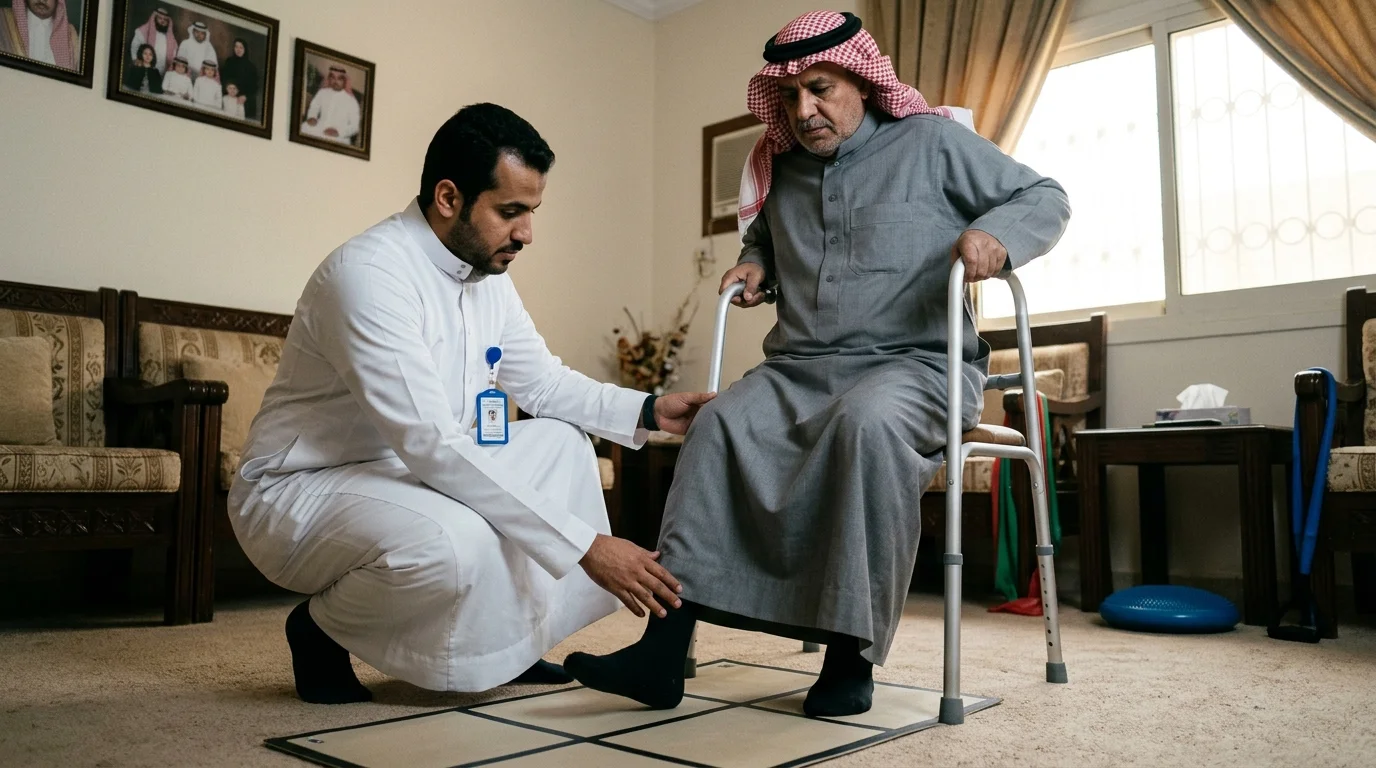
Specialized post-stroke neuro-physiotherapist assisting hemiplegic patient with weight shifting and calibrated stepping at home
Crucial Medical Triage: Acute Stroke Symptoms Require Immediate Emergency Care

If you or a family member observe sudden facial drooping, unilateral arm weakness, speech difficulty, or sudden severe loss of balance (FAST protocol): Do NOT wait for home therapy. Immediately call the Saudi Red Crescent (997) or proceed to the nearest hospital emergency room. Every minute saves brain cells.

Saudi Emergency: 997Home neuro-rehabilitation at Bidaya begins only after comprehensive medical stabilization in hospital.
1

Crucial Stroke Emergency Triage: The FAST Protocol and Calling 997

A strict, vital distinction must be maintained between two distinct phases of stroke management:

Phase 1: The Acute Emergency Window (0 - 24 Hours): If a patient exhibits sudden facial droop, acute unilateral arm drift, slurred or absent speech, or acute loss of balance (the FAST protocol): do NOT wait for physiotherapy. Immediately dial Saudi Red Crescent (997) or proceed directly to an emergency department equipped with acute stroke thrombolysis (tPA) and endovascular thrombectomy services. Every minute saves approximately 1.9 million neurons.

Phase 2: Post-Acute Rehabilitation (Subacute to Chronic): Once the patient is medically stabilized in the hospital and cleared for discharge, Bidaya's home neuro-rehabilitation begins. We guide the long-term neuroplastic reorganization of motor pathways directly within the patient's residence.

Call 997 immediately upon acute symptom onset; never administer home medications or delay transport.
Home neuro-rehabilitation commences promptly following medical discharge and consultant clearance.
Capitalizing on the crucial early 3-to-6 month neuroplastic window.
Preventing debilitating secondary complications such as contractures and learned non-use.
2

Neuropathology and Cortical Neuroplasticity Mechanisms

A cerebrovascular accident (CVA) results from focal cerebral ischemia (85% of cases) or intracerebral hemorrhage (15%), destroying descending corticospinal tracts and interrupting primary motor cortex output. Surrounding the ischemic core lies the 'penumbra' — structurally viable tissue salvageable through medical stabilization and motor training.

Recovery relies on neuroplasticity: the central nervous system's capacity to recruit peri-infarct cortex, activate uncrossed descending motor pathways, and establish novel synaptic connections. However, unguided recovery often leads to 'maladaptive plasticity', where the patient compensates exclusively with the non-paretic side, cementing severe spasticity and functional non-use in the affected arm and leg. Bidaya's structured, high-intensity home protocols counteract maladaptation and stimulate true motor relearning.

3

Brunnstrom Stages of Motor Recovery Framework

Bidaya clinicians evaluate and progress stroke survivors through established Brunnstrom Stages:

Stage 1: Complete Flaccidity: Total absence of voluntary or reflex movement. Focus: positioning, joint range of motion, shoulder subluxation prevention, and sensory stimulation.

Stage 2: Emergence of Spasticity: Basic flexor/extensor synergy patterns emerge reflexively. Focus: facilitating minimal voluntary movement without elevating resting muscle tone.

Stage 3: Peak Spasticity: Severe hypertonia with voluntary movement locked within stereotyped synergy patterns. Focus: synergy inhibition, prolonged sustained stretching, and reciprocal facilitation.

Stage 4: Spasticity Declines & Out-of-Synergy Movement: Patient begins isolating movements outside synergy (e.g., placing hand behind back, reaching with elbow extended). Focus: functional task retraining.

Stage 5: Advanced Voluntary Control: Synergies lose dominance; complex movement combinations emerge. Focus: velocity, coordination, and functional gait refinement.

Stage 6: Near-Normal Coordination: Disappearance of spasticity and restoration of isolated joint control. Focus: community endurance, dual-task mobility, and recreational reintegration.

4

Upper Limb Function and Shoulder Subluxation Prevention

Due to vast motor cortex representation, arm and hand recovery is clinically challenging. Flaccidity in the supraspinatus and deltoid muscles allows gravity to drag the humeral head out of the glenoid fossa, producing painful inferior shoulder subluxation. Bidaya utilizes functional strapping, neuromuscular stimulation (NMES), and scapular stabilization to protect the shoulder while systematically retraining reach, grasp, and manipulation with real domestic objects.

5

Rebuilding Symmetrical Weight-Bearing and Walking

Stroke survivors naturally shift 80-90% of body weight to the unaffected leg, resulting in abnormal circumduction gait. Our therapists retrain symmetrical stance stability, facilitate hip extension in midstance, control knee hyperextension (recurvatum), and ensure safe toe clearance using dynamic AFO orthoses or peroneal nerve stimulation.

6

Advanced In-Home Clinical Assessment Battery and SMART Milestones for Stroke & Hemiplegia

The clinical success of in-home neurological rehabilitation for Stroke & Hemiplegia depends fundamentally on the depth and precision of the baseline diagnostic evaluation performed in the patient's residence. Rather than relying on subjective observation or generic exercise routines, Bidaya implements an internationally standardized clinical assessment battery designed to map the structural and functional integrity of the central and peripheral nervous systems.

Our comprehensive baseline evaluation quantifies muscle tone and velocity-dependent spasticity using the Modified Ashworth Scale (MAS), isolates selective voluntary motor control outside pathological mass synergies via the Fugl-Meyer Assessment (FMA), and evaluates static and dynamic equilibrium using the Berg Balance Scale (BBS) and the Timed Up and Go (TUG) test. Sensory modalities — including light touch discrimination, pinprick, and joint position sense (proprioception) — are meticulously charted to identify sensory ataxia or neglect syndromes.

Based on these objective metrics, our senior neurological physiotherapist collaborates with the patient and family to establish Specific, Measurable, Achievable, Relevant, and Time-bound (SMART) functional milestones. These goals are explicitly tied to authentic daily domestic routines: mastering unassisted rolling in bed within two weeks, rising autonomously from a standard residential armchair within four weeks, or achieving stable indoor ambulation across domestic hallways without physical assistance.

Precise neurological documentation tracking deep tendon reflexes and clonus suppression.
Continuous physiological monitoring of blood pressure, heart rate, and oxygen saturation during exertion.
Targeted identification of isolated muscle deficits to guide functional neuromuscular stimulation (NMES).
Sharing comprehensive digital progress summaries with treating physicians across Eastern Province hospitals.
7

Caregiver Empowerment and Domestic Safety Protocols for Stroke & Hemiplegia

Extensive peer-reviewed rehabilitation research demonstrates that while direct clinical therapy sessions provide high-intensity neuroplastic stimulation, the remaining 23 hours of the patient's day are managed by family members and domestic caregivers. If caregivers lack proper biomechanical training, well-intentioned assistance — such as aggressively pulling on a hemiparetic arm during transfers — can produce catastrophic musculoskeletal injuries, severe shoulder subluxation, and chronic pain syndromes.

Bidaya dedicates structured time during every home visit to coach family members and domestic nurses in safe, ergonomic transfer mechanics. We train the biomechanical 'Head-Hips Relationship' to facilitate effortless transfers between bed, wheelchair, and sofa without placing compressive strain on the caregiver's spine, alongside strict rotational repositioning protocols to eliminate pressure injury risks.

Furthermore, we provide structured, illustrated Home Exercise Programs (HEP) detailing gentle active-assisted movements, safe positioning techniques using anatomical pillows, and clear activity boundaries, transforming the household into an empowering 24-hour therapeutic sanctuary.

Strict prohibition of traction forces on the paretic shoulder to prevent rotator cuff tears.
Anatomical positioning guidelines using contoured pillows to preserve symmetrical trunk alignment.
Training caregivers to encourage active patient participation rather than fostering learned helplessness.
Direct coordination channels with the supervising clinician for prompt guidance on daily care challenges.
8

Local Residential Adaptation and Mobile Clinical Field Logistics in Eastern Province

Residential properties in Eastern Province feature generous architectural spaces that provide outstanding opportunities for neurological motor relearning, including expansive living halls, wide hallways, and private outdoor verandas. However, these spaces also present real-world environmental hazards — such as polished marble flooring, decorative floor rugs, and threshold steps — that can precipitate dangerous falls if unmanaged.

During our initial home visits in Eastern Province, Bidaya clinicians conduct a thorough domestic safety audit, identifying slip and trip hazards and advising families on practical, unobtrusive modifications. These include securing rug perimeters, recommending secure wall-mounted grab bars in bathrooms, optimizing lighting along nocturnal pathways, and adjusting seating heights to match the patient's biomechanical joint angles.

Moreover, our mobile operations in Eastern Province are strategically scheduled by regional neighborhood clusters, ensuring prompt, reliable arrival that avoids peak arterial highway congestion and preserves the patient's physiological stamina for productive therapeutic exercise.

Systematic hazard screening across hallways, thresholds, and bathroom transfer zones.
Optimizing residential seating heights to facilitate natural sit-to-stand momentum transfer.
Coordinating session arrival to harmonize with patient medication schedules and prayer times.
Customizing mobility training to the unique architectural dimensions of the patient's residence.
9

Comprehensive Clinical Prevention of Secondary Complications in Stroke & Hemiplegia

Effective management of chronic or subacute Stroke & Hemiplegia requires aggressive prevention of secondary complications arising from prolonged immobility or abnormal compensatory kinematics. Left unaddressed, these secondary pathologies can become more physically limiting and painful than the primary neurological lesion itself.

Chief among these risks are fixed soft-tissue contractures resulting from sustained uninhibited spasticity, disuse osteoporosis caused by lack of skeletal axial loading, dependent peripheral edema with deep vein thrombosis (DVT) risk, and pulmonary atelectasis stemming from shallow diaphragmatic excursion during prolonged recumbency.

Bidaya's home neuro-physiotherapy integrates multi-tiered preventive strategies: applying sustained low-load prolonged stretching to vulnerable muscle groups, introducing supported weight-bearing standing protocols to stimulate osteogenesis, utilizing active muscle pumps and electrical stimulation to enhance venous return, and practicing deep diaphragmatic re-expansion to maintain pulmonary compliance.

Regular passive and active-assisted range of motion protocols to preserve articular mobility.
Facilitating safe upright standing to stimulate bone mineral density and reduce spastic tone.
Activating calf muscle pump mechanisms to prevent dependent peripheral edema and circulatory stasis.
Incentive spirometry and diaphragmatic breathing exercises to safeguard respiratory vitality.
10

Clinical Governance, Objective Documentation, and Quality Benchmarks at Bidaya

Bidaya adheres strictly to international clinical governance frameworks established by premier neurological physical therapy organizations worldwide. Our home visit service is characterized by rigorous longitudinal documentation and transparent milestone verification using validated outcome batteries.

At the conclusion of each therapeutic block, our supervising clinical director reviews serial functional scores (Fugl-Meyer, Berg Balance, TUG, and Modified Barthel Index), synthesizing these data points into an encrypted clinical progress report. This report is shared directly with the patient, family, and treating neurologist at tertiary centers across the Eastern Province, ensuring seamless multidisciplinary continuity of care.

Serial digital outcome tracking verifying functional gains at standardized intervals.
Peer-reviewed clinical protocol updates incorporating the latest neuroplasticity research.
Absolute confidentiality and ethical data stewardship safeguarding family medical privacy.
Uncompromising dedication to restoring patient dignity, self-reliance, and physical autonomy.

Clinical Topics in Stroke & Hemiplegia Recovery

Home Stroke Rehabilitation: Practical Recovery from Bed to CommunityEastern ProvinceIn-Home Hemiplegia Rehabilitation and Motor Control RecoveryEastern ProvinceIn-Home Post-Stroke Hand & Fine Motor Dexterity RehabilitationEastern ProvinceIn-Home Post-Stroke Arm Weakness & Shoulder RecoveryEastern ProvinceIn-Home Post-Stroke Spasticity Management & Muscle Tone ControlEastern ProvinceIn-Home Transfer Training & Bed-to-Chair Mobility Post-StrokeEastern ProvinceIn-Home Sit-to-Stand Biomechanical Retraining After StrokeEastern ProvinceIn-Home Bed Mobility & Trunk Rotation Retraining Post-StrokeEastern ProvinceIn-Home Shoulder Subluxation Management & Pain Relief Post-StrokeEastern ProvinceCane Gait Retraining & Progression to Unassisted Walking Post-StrokeEastern ProvinceFamily Caregiver Training & Safe Handling Guide for StrokeEastern ProvinceIn-Home Geriatric Stroke Rehabilitation in Eastern ProvinceEastern ProvinceChronic Stroke Rehabilitation & Long-Term Neuroplasticity at HomeEastern ProvincePreventing Contractures & Secondary Complications Post-StrokeEastern ProvinceWhen Should In-Home Stroke Physiotherapy Begin?Eastern ProvinceHow Long Does Stroke Rehabilitation & Motor Recovery Take?Eastern ProvinceWhy Stroke Patients Drag Their Foot and How It Is TreatedEastern ProvinceWhy Does the Hand Remain Clenched After Stroke & How to Treat ItEastern ProvinceEvidence-Based In-Home Motor Recovery Exercises After StrokeEastern ProvinceIn-Home Sit-to-Stand Biomechanical Retraining in Neurological RehabilitationEastern ProvinceIn-Home Bed Mobility, Rolling & Transfer Retraining for Neurological CareEastern ProvinceFamily Clinical Triage & Care Guide for In-Home Post-Stroke RecoveryEastern ProvinceTrunk Control & Core Stability Retraining After StrokeEastern ProvinceWeight Bearing & Lower Limb Loading Protocols After StrokeEastern ProvinceGenu Recurvatum & Knee Hyperextension Management After StrokeEastern ProvinceStep Initiation & Walking Cadence Training After StrokeEastern ProvinceSafe Pivot Turning & Direction Change After StrokeEastern ProvinceCircumduction Gait & Hip Hitching Correction After StrokeEastern ProvinceFloor Transfer & Post-Fall Recovery Training After StrokeEastern ProvinceToilet Transfers & Bathroom Safety Retraining After StrokeEastern ProvinceCar Transfers & Vehicle Passenger Mobility After StrokeEastern ProvinceHemiplegic Shoulder Subluxation Support & Taping After StrokeEastern ProvinceFinger Extensor Facilitation & Release Training After StrokeEastern ProvinceFine Motor Dexterity & Daily Bimanual Tasks After StrokeEastern ProvinceConstraint-Induced Movement Therapy (CIMT) for StrokeEastern ProvinceMirror Therapy for Motor Relearning & Neuroplasticity After StrokeEastern ProvinceMental Practice & Motor Imagery in Post-Stroke RehabilitationEastern ProvinceFunctional Electrical Stimulation (FES) in Stroke Neuro-RehabEastern ProvinceSensory Re-Education & Proprioception Training After StrokeEastern ProvinceHemispatial Neglect & Unilateral Inattention Rehabilitation After StrokeEastern ProvinceMotor Apraxia & Movement Sequencing Therapy After StrokeEastern ProvincePusher Syndrome & Contra-Aversive Postural Tilt RehabilitationEastern ProvinceCentral Post-Stroke Pain (CPSP) & Neuropathic ManagementEastern ProvincePost-Stroke Fatigue Management & Energy Conservation StrategiesEastern ProvinceOvercoming Post-Stroke Apathy & Depression in Motor RehabilitationEastern ProvinceBed Positioning & Sleep Posture Protocols for Stroke RecoveryEastern ProvinceSingle-Arm & Foot Wheelchair Propulsion Skills After StrokeEastern ProvinceCommunity Reintegration & Advanced Outdoor Mobility After StrokeEastern ProvinceWhy Post-Stroke Recovery Plateaus & Strategies to Break StagnationEastern ProvinceCan Post-Stroke Spasticity Disappear or Is It Managed Functionally?Eastern ProvinceBiomechanics of Rising from Low Traditional Majlis SeatingEastern ProvinceShower Chair Transfers & In-Home Neurological Bathroom ErgonomicsEastern ProvinceIn-Home Stroke Rehabilitation & Motor Relearning in Al OyoonAl OyoonIn-Home Stroke Rehabilitation & Functional Care in Al OmranAl OmranIn-Home Stroke Rehabilitation & Mobility Recovery in Al TarafAl TarafIn-Home Stroke Rehabilitation & Physiotherapy in Al JafrAl JafrAutonomous Wheelchair Propulsion & Shoulder Joint ProtectionEastern ProvinceChronic Stroke Neuro-Rehabilitation Beyond the One-Year MilestoneEastern ProvincePersistent Flaccid Hand & Extensor Digit Activation Post-StrokeEastern ProvinceHemiplegic Shoulder Subluxation & Glenohumeral Slings Post-StrokeEastern ProvinceHemiplegic Shoulder Pain Prevention & Safe Upper Limb HandlingEastern ProvinceCentral Post-Stroke Sensory Re-Education & Cortical Re-MappingEastern ProvinceNeuroanatomy Rationale: Why Lower Extremity Recovers Faster Than HandEastern ProvinceHow Family Caregivers Safely Assist Sit-to-Stand TransfersEastern ProvinceNeuroplasticity Potential & Functional Recovery in Geriatric Stroke PatientsEastern Province
Free Self-Check

Is In-Home Neuro Rehabilitation Suitable for Your Case?

Answer 4 brief questions to determine whether in-home physical therapy matches your mobility goals and care needs.

Frequently Asked Clinical Questions

Q

When should home physiotherapy begin after hospital discharge for a stroke?

Rehabilitation should begin within 24 to 48 hours of discharge, provided the patient is medically cleared by their treating neurologist. Immediate initiation capitalizes on peak neuroplastic responsiveness.

Q

Does Bidaya guarantee that a stroke patient will walk independently?

No ethical medical provider can offer guaranteed outcomes; neurological recovery depends on lesion volume, location, patient age, and neural reserve. We guarantee rigorous evidence-based care to maximize every patient's potential.

Q

What is the recommended weekly session frequency for active stroke recovery?

During the first 3 to 6 months post-stroke, we recommend 3 to 5 sessions per week to deliver sufficient repetition volume for cortical reorganization.

Q

Why does the stroke patient experience severe shoulder pain, and how is it treated?

Post-stroke shoulder pain typically stems from subluxation or rotator cuff impingement. It is managed through anatomical support, scapular alignment, NMES, and eliminating harmful traction during transfers.

Q

Can stroke patients with aphasia or speech impairment participate in therapy?

Yes. Our clinicians utilize visual demonstrations, tactile guidance, and structured non-verbal cueing to ensure smooth, successful exercise participation.

Q

How do we schedule a post-stroke in-home evaluation in Dammam or Khobar?

Call our official number 01097079170 or contact us via WhatsApp (201097079170) with discharge details to schedule an initial clinical evaluation.

Regional Coverage Matrix

In-Home Stroke & Hemiplegia Across Eastern Province

Our licensed neuro-physiotherapists deliver home-based rehabilitation programs to patients' residences in the following major cities:

Bidaya Neuro-Rehabilitation Clinical Review BoardClinical Governance
Multidisciplinary Physical Therapy & Neurological Care Panel — Eastern Province
Last Clinical Review: 2026-09-03
Editorial Standards
Evidence-Based Clinical References
  • Winstein CJ, et al. Guidelines for Adult Stroke Rehabilitation and Recovery: AHA/ASA. Stroke. 2016.
  • Brunnstrom S. Movement Therapy in Hemiplegia. Harper & Row; 1970.
  • Kwakkel G, et al. Augmented exercise therapy on gait outcome after stroke. Cochrane Database Syst Rev. 2004.
  • Bohannon RW, Smith MB. Modified Ashworth scale reliability. Phys Ther. 1987.
Clinical Governance & Care Standards

Why Families Trust Bidaya Home Neuro-Rehab

Evidence-informed neurological care delivered with domestic safety, medical ethics, and documented functional recovery.

100% Dedicated In-Home Care

Eliminates transportation strain and clinical waiting times for neurological patients.

Licensed Clinical Professionals

Qualified physical therapists trained in adult neurological rehabilitation.

Standardized Outcome Measures

Baseline assessment and objective tracking using validated international metrics.

Caregiver & Family Training

Instruction on safe transfer mechanics, positioning, and daily home routines.

Exclusive Neurological Focus

Specialized clinical programs tailored to stroke, Parkinson's, and mobility disorders.

Eastern Province Wide Coverage

Scheduled home care visits covering Dammam, Khobar, Dhahran, Qatif, Jubail, and Al-Ahsa.

All clinical sessions are scheduled following an initial in-home clinical needs assessment.