Mobile Neuro-Physiotherapy Visits Across Eastern Province — 100% Home Delivery
•Eastern Province Scheduled Visits
Advanced In-Home Neurological Physiotherapy • Eastern Province
Live Home Visits Available

Bidaya: Advanced Home Neurological Physiotherapy in Eastern Province

Delivering hospital-grade neurological physiotherapy directly into the comfort and dignity of your home in Eastern Province. We spare vulnerable patients the stress of transit, retraining neural pathways in the authentic home environment to restore functional independence.

100% dedicated in-home care with zero patient transportation hassle
Neuroplasticity-driven tailored protocols for stroke, SCI, MS, and gait disorders
Licensed Saudi Commission for Health Specialties (SCFHS) physical therapists
Standardized objective clinical metrics (Berg, Ashworth, TUG) tracking weekly gains
4.9/5 ⭐⭐⭐⭐⭐ (Trusted by 450+ families across Eastern Province)
Clinical triage response on WhatsApp within 15 minutes
Male & Female Specialists Available
Direct home visits scheduled in Dammam, Khobar, Dhahran, Qatif, Saihat, Jubail, & Al-Ahsa.
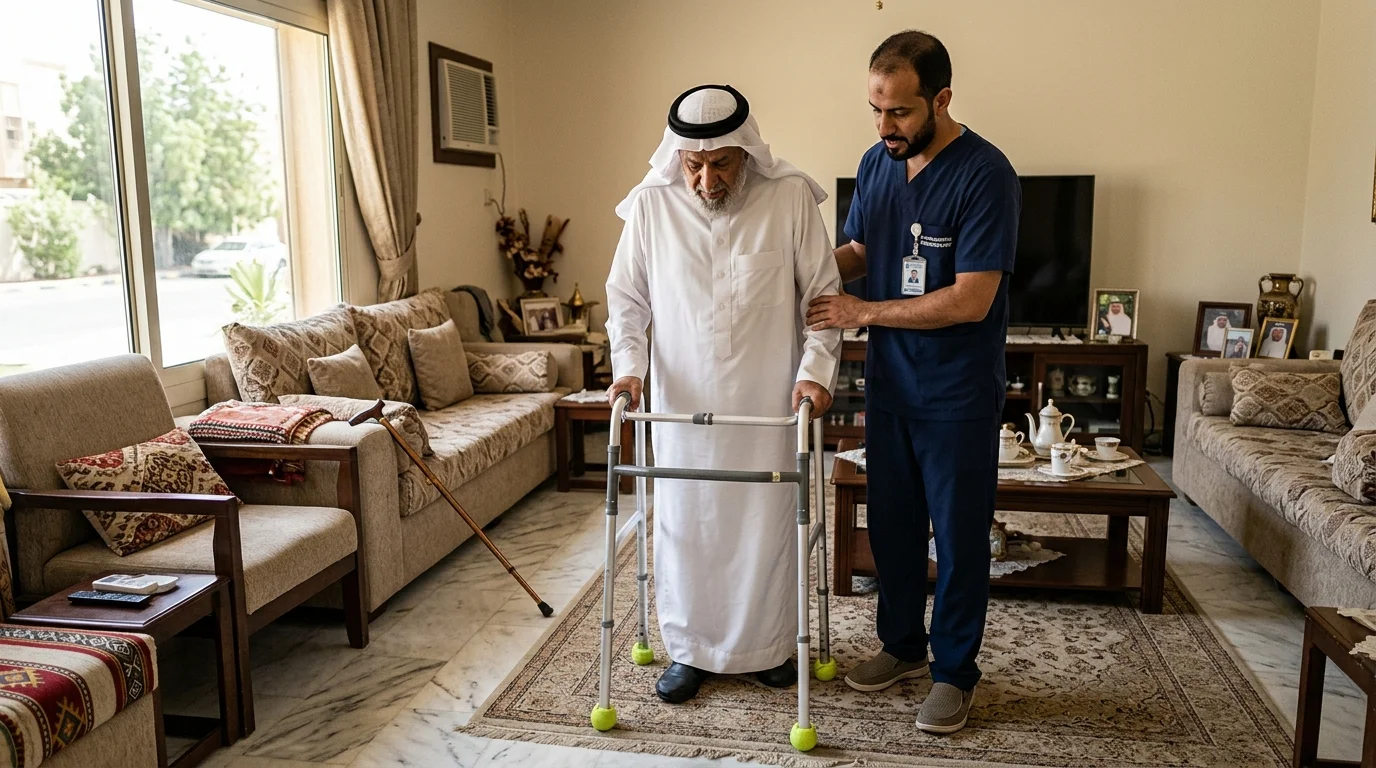
Bidaya specialized neuro-physiotherapist supporting an elderly patient during a home rehabilitation session in the Eastern Province
1

Our Clinical Philosophy: Why In-Home Neuro Rehabilitation in Eastern Province?

Recovering from a severe neurological event — such as an ischemic or hemorrhagic stroke, traumatic brain injury, spinal cord lesion, or progressive neurodegenerative diseases like Parkinson's and Multiple Sclerosis — is a demanding journey that requires daily clinical momentum and task-specific repetition. Across the sprawling metropolitan centers of Saudi Arabia's Eastern Province, including Dammam, Al Khobar, and Dhahran, patients with compromised mobility face immense physical and logistical obstacles when trying to access outpatient hospital clinics.

Transferring an individual with hemiplegia, severe balance ataxia, or wheel-chair dependency from a private residence involves multiple stressful transfers: bed to wheelchair, wheelchair through elevators or stairs, into a passenger vehicle, navigating dense regional highway traffic, finding parking, and enduring sterile hospital waiting rooms. This arduous journey depletes the patient's neurological stamina and physical reserves long before the therapy session even begins.

Bidaya Neurological Rehabilitation was established to reverse this paradigm. We bring the specialized outpatient neuro-rehab clinic directly into the patient's primary living space. By transforming the home into an enriched motor learning environment, our licensed neurological therapists train patients on their actual furniture, hallways, staircases, and bathrooms. This contextual retraining directly translates into sustainable functional independence and family peace of mind.

Eliminates painful, risky transfers and highway transport for vulnerable neurological patients.
Preserves 100% of the patient's daily cognitive and motor energy for purposeful therapeutic practice.
Directly addresses architectural barriers in modern Saudi villas and apartments.
Protects immunocompromised and elderly individuals from nosocomial hospital-acquired infections.
2

Comprehensive Neurological Conditions Treated in Home Care

Unlike general orthopedic practices that focus on joint sprains or sports injuries, Bidaya is exclusively dedicated to central and peripheral nervous system rehabilitation. Our specialized protocols address:

1. Post-Stroke Rehabilitation (Hemiplegia & Hemiparesis): Cortical reorganization, synergy dissociation, spasticity management via prolonged elongation, upper limb dexterity recovery, and symmetrical gait retraining.

2. Parkinson's Disease & Movement Disorders: Overcoming hypokinesia and bradykinesia through amplitude-based motor protocols (LSVT BIG concepts) and visual/auditory rhythmic sensory cueing to prevent freezing of gait (FOG).

3. Spinal Cord Injury (Paraplegia & Tetraplegia): Maximizing residual functional motor units, safe sliding board transfer training, wheelchair propulsion ergonomics, and pelvic/trunk stability.

4. Multiple Sclerosis (MS): Energy conservation training (the 4 P's), core stabilization, and temperature-regulated therapeutic exercise designed specifically for the Eastern Province climate.

5. Neurological Gait & Balance Disorders: Sensory integration retraining across vestibular, visual, and somatosensory systems to prevent devastating falls in the home.

6. Peripheral Neuropathy & Foot Drop: Peroneal nerve stimulation, functional orthotic tuning (AFO), and high-steppage gait correction.

3

Objective Clinical Assessment and Measurement in the Home

Every Bidaya therapeutic relationship initiates with a comprehensive, standardized baseline clinical evaluation conducted in the patient's residence. We do not rely on subjective guesswork; our licensed neuro-physiotherapists utilize internationally validated clinical rating scales:

We evaluate muscle tone and spasticity using the Modified Ashworth Scale (MAS), assess motor recovery stages using the Fugl-Meyer Assessment (FMA), and quantify balance and fall risks through the Berg Balance Scale (BBS) and Timed Up and Go (TUG) tests.

Sensory modalities, including light touch, pinprick, and joint proprioception, are meticulously mapped. Serial measurements are documented in an encrypted clinical dashboard, allowing seamless reporting to the patient's treating neurologist or physiatrist at tertiary centers across the Eastern Province.

4

Harnessing Neuroplasticity in the Natural Living Environment

Neuroplasticity — the central nervous system's capacity to modify its structural and functional connectivity in response to experiential demand — is guided by ten fundamental principles established in modern neuroscience. Among these, task specificity, high repetition volume, and behavioral salience are paramount.

Practicing reaching for a clinical plastic cone in a sterile gym lacks the neural salience of reaching for an actual tea cup in the family living room. By anchoring therapeutic tasks to meaningful daily rituals, Bidaya maximizes cortical reorganization and promotes long-term motor skill retention.

5

Caregiver Coaching and Family Empowerment

While our specialized therapists provide intensive one-on-one therapy during scheduled sessions, the remaining 23 hours of the day are managed by family members and domestic caregivers. If transfers are executed improperly — such as pulling on a flaccid hemiplegic arm — severe complications like shoulder subluxation and chronic pain can emerge.

Bidaya dedicates structured time in every session to coach caregivers in safe biomechanical transfers, therapeutic positioning, pressure sore prevention, and safe mobility spotting, turning the family circle into an empowered therapeutic alliance.

6

Field Logistics Across Dammam, Al Khobar, Dhahran, and Regional Hubs

Our scheduled home visits operate throughout the greater Eastern Province, serving residential districts in Dammam (Al Faisaliyah, Al Shati, Al Mazrouiyah), Al Khobar (Al Rakah, Al Hizam, Al Olaya, Corniche), Dhahran (Doha Hills, Al Dana, KFUPM area), Qatif, Jubail, and Al-Ahsa.

We reiterate with absolute professional transparency that Bidaya operates exclusively as a specialized home visit provider. We do not maintain walk-in outpatient clinics in these cities; our clinical teams travel directly to your doorstep with full portable medical equipment kits.

7

Advanced In-Home Clinical Assessment Battery and SMART Milestones for Comprehensive Neuro Rehabilitation

The clinical success of in-home neurological rehabilitation for Comprehensive Neuro Rehabilitation depends fundamentally on the depth and precision of the baseline diagnostic evaluation performed in the patient's residence. Rather than relying on subjective observation or generic exercise routines, Bidaya implements an internationally standardized clinical assessment battery designed to map the structural and functional integrity of the central and peripheral nervous systems.

Our comprehensive baseline evaluation quantifies muscle tone and velocity-dependent spasticity using the Modified Ashworth Scale (MAS), isolates selective voluntary motor control outside pathological mass synergies via the Fugl-Meyer Assessment (FMA), and evaluates static and dynamic equilibrium using the Berg Balance Scale (BBS) and the Timed Up and Go (TUG) test. Sensory modalities — including light touch discrimination, pinprick, and joint position sense (proprioception) — are meticulously charted to identify sensory ataxia or neglect syndromes.

Based on these objective metrics, our senior neurological physiotherapist collaborates with the patient and family to establish Specific, Measurable, Achievable, Relevant, and Time-bound (SMART) functional milestones. These goals are explicitly tied to authentic daily domestic routines: mastering unassisted rolling in bed within two weeks, rising autonomously from a standard residential armchair within four weeks, or achieving stable indoor ambulation across domestic hallways without physical assistance.

Precise neurological documentation tracking deep tendon reflexes and clonus suppression.
Continuous physiological monitoring of blood pressure, heart rate, and oxygen saturation during exertion.
Targeted identification of isolated muscle deficits to guide functional neuromuscular stimulation (NMES).
Sharing comprehensive digital progress summaries with treating physicians across Eastern Province hospitals.
8

Caregiver Empowerment and Domestic Safety Protocols for Comprehensive Neuro Rehabilitation

Extensive peer-reviewed rehabilitation research demonstrates that while direct clinical therapy sessions provide high-intensity neuroplastic stimulation, the remaining 23 hours of the patient's day are managed by family members and domestic caregivers. If caregivers lack proper biomechanical training, well-intentioned assistance — such as aggressively pulling on a hemiparetic arm during transfers — can produce catastrophic musculoskeletal injuries, severe shoulder subluxation, and chronic pain syndromes.

Bidaya dedicates structured time during every home visit to coach family members and domestic nurses in safe, ergonomic transfer mechanics. We train the biomechanical 'Head-Hips Relationship' to facilitate effortless transfers between bed, wheelchair, and sofa without placing compressive strain on the caregiver's spine, alongside strict rotational repositioning protocols to eliminate pressure injury risks.

Furthermore, we provide structured, illustrated Home Exercise Programs (HEP) detailing gentle active-assisted movements, safe positioning techniques using anatomical pillows, and clear activity boundaries, transforming the household into an empowering 24-hour therapeutic sanctuary.

Strict prohibition of traction forces on the paretic shoulder to prevent rotator cuff tears.
Anatomical positioning guidelines using contoured pillows to preserve symmetrical trunk alignment.
Training caregivers to encourage active patient participation rather than fostering learned helplessness.
Direct coordination channels with the supervising clinician for prompt guidance on daily care challenges.
9

Local Residential Adaptation and Mobile Clinical Field Logistics in Eastern Province

Residential properties in Eastern Province feature generous architectural spaces that provide outstanding opportunities for neurological motor relearning, including expansive living halls, wide hallways, and private outdoor verandas. However, these spaces also present real-world environmental hazards — such as polished marble flooring, decorative floor rugs, and threshold steps — that can precipitate dangerous falls if unmanaged.

During our initial home visits in Eastern Province, Bidaya clinicians conduct a thorough domestic safety audit, identifying slip and trip hazards and advising families on practical, unobtrusive modifications. These include securing rug perimeters, recommending secure wall-mounted grab bars in bathrooms, optimizing lighting along nocturnal pathways, and adjusting seating heights to match the patient's biomechanical joint angles.

Moreover, our mobile operations in Eastern Province are strategically scheduled by regional neighborhood clusters, ensuring prompt, reliable arrival that avoids peak arterial highway congestion and preserves the patient's physiological stamina for productive therapeutic exercise.

Systematic hazard screening across hallways, thresholds, and bathroom transfer zones.
Optimizing residential seating heights to facilitate natural sit-to-stand momentum transfer.
Coordinating session arrival to harmonize with patient medication schedules and prayer times.
Customizing mobility training to the unique architectural dimensions of the patient's residence.
10

Comprehensive Clinical Prevention of Secondary Complications in Comprehensive Neuro Rehabilitation

Effective management of chronic or subacute Comprehensive Neuro Rehabilitation requires aggressive prevention of secondary complications arising from prolonged immobility or abnormal compensatory kinematics. Left unaddressed, these secondary pathologies can become more physically limiting and painful than the primary neurological lesion itself.

Chief among these risks are fixed soft-tissue contractures resulting from sustained uninhibited spasticity, disuse osteoporosis caused by lack of skeletal axial loading, dependent peripheral edema with deep vein thrombosis (DVT) risk, and pulmonary atelectasis stemming from shallow diaphragmatic excursion during prolonged recumbency.

Bidaya's home neuro-physiotherapy integrates multi-tiered preventive strategies: applying sustained low-load prolonged stretching to vulnerable muscle groups, introducing supported weight-bearing standing protocols to stimulate osteogenesis, utilizing active muscle pumps and electrical stimulation to enhance venous return, and practicing deep diaphragmatic re-expansion to maintain pulmonary compliance.

Regular passive and active-assisted range of motion protocols to preserve articular mobility.
Facilitating safe upright standing to stimulate bone mineral density and reduce spastic tone.
Activating calf muscle pump mechanisms to prevent dependent peripheral edema and circulatory stasis.
Incentive spirometry and diaphragmatic breathing exercises to safeguard respiratory vitality.
Free Self-Check

Is In-Home Neuro Rehabilitation Suitable for Your Case?

Answer 4 brief questions to determine whether in-home physical therapy matches your mobility goals and care needs.

Frequently Asked Clinical Questions

Q

How does neurological physiotherapy differ from general orthopedic physical therapy?

Neurological physiotherapy specializes in rehabilitating the central and peripheral nervous systems following brain or spinal lesions. Rather than treating local tendonitis or joint arthritis, it focuses on brain plasticity, sensory integration, motor control, spasticity suppression, and functional movement relearning.

Q

Can in-home neuro rehabilitation achieve the same outcomes as specialized hospital clinics?

Extensive peer-reviewed clinical trials demonstrate that intensive in-home rehabilitation produces equal or superior functional recovery compared to outpatient centers. Home therapy eliminates patient transport fatigue, avoids nosocomial infection risks, and trains real-world motor tasks directly in the patient's actual living environment.

Q

How is the rehabilitation plan and weekly session frequency determined?

Session frequency is customized following our comprehensive baseline in-home evaluation. Depending on lesion chronicity, motor recovery phase, and clinical goals, programs typically range from 3 to 5 intensive sessions per week for active post-stroke or post-surgical recovery.

Q

Do you provide licensed female therapists for female patients in Eastern Province?

Yes. Bidaya deeply respects the social and cultural privacy of all Saudi families. We provide highly qualified, licensed female neuro-physiotherapists for female patients, coordinated in advance during the intake process.

Q

Which specific cities and districts are covered by your home visit service?

Our clinical teams provide scheduled home visits across Dammam, Al Khobar, Dhahran, Qatif, Saihat, Safwa, Jubail, and Al-Ahsa (Al Hofuf and Al Mubarraz). Please contact our clinical coordinator to verify exact neighborhood scheduling.

Q

What equipment does the therapist bring to our home during sessions?

Our mobile neuro kits include portable neuromuscular electrical stimulators (NMES), calibrated balance foam pads, clinical dynamometers, sensory re-education tools, gait safety belts, and fine motor upper extremity retraining apparatus.

Specialized Clinical Programs

In-Home Neurological Care Available in Eastern Province

Explore our core neurological rehabilitation programs delivered by appointment directly to residences across Eastern Province:

Bidaya Neuro-Rehabilitation Clinical Review BoardClinical Governance
Multidisciplinary Physical Therapy & Neurological Care Panel — Eastern Province
Last Clinical Review: 2026-09-03
Editorial Standards
Evidence-Based Clinical References
  • Winstein CJ, et al. Guidelines for Adult Stroke Rehabilitation and Recovery: AHA/ASA. Stroke. 2016.
  • Dobkin BH. Strategies for stroke rehabilitation. Lancet Neurol. 2004.
  • Kleim JA, Jones TA. Principles of experience-dependent neural plasticity. J Speech Lang Hear Res. 2008.
  • Langhorne P, et al. Early supported discharge services for stroke patients. Cochrane Database Syst Rev. 2017.
Clinical Governance & Care Standards

Why Families Trust Bidaya Home Neuro-Rehab

Evidence-informed neurological care delivered with domestic safety, medical ethics, and documented functional recovery.

100% Dedicated In-Home Care

Eliminates transportation strain and clinical waiting times for neurological patients.

Licensed Clinical Professionals

Qualified physical therapists trained in adult neurological rehabilitation.

Standardized Outcome Measures

Baseline assessment and objective tracking using validated international metrics.

Caregiver & Family Training

Instruction on safe transfer mechanics, positioning, and daily home routines.

Exclusive Neurological Focus

Specialized clinical programs tailored to stroke, Parkinson's, and mobility disorders.

Eastern Province Wide Coverage

Scheduled home care visits covering Dammam, Khobar, Dhahran, Qatif, Jubail, and Al-Ahsa.

All clinical sessions are scheduled following an initial in-home clinical needs assessment.