Mobile Neuro-Physiotherapy Visits Across Eastern Province — 100% Home Delivery
•Eastern Province Scheduled Visits
Advanced In-Home Neurological Physiotherapy • Eastern Province
Live Home Visits Available

Neurological Gait Rehabilitation and Walking Retraining

Delivering hospital-grade neurological physiotherapy directly into the comfort and dignity of your home in Eastern Province. We spare vulnerable patients the stress of transit, retraining neural pathways in the authentic home environment to restore functional independence.

100% dedicated in-home care with zero patient transportation hassle
Neuroplasticity-driven tailored protocols for stroke, SCI, MS, and gait disorders
Licensed Saudi Commission for Health Specialties (SCFHS) physical therapists
Standardized objective clinical metrics (Berg, Ashworth, TUG) tracking weekly gains
4.9/5 ⭐⭐⭐⭐⭐ (Trusted by 450+ families across Eastern Province)
Clinical triage response on WhatsApp within 15 minutes
Male & Female Specialists Available
Direct home visits scheduled in Dammam, Khobar, Dhahran, Qatif, Saihat, Jubail, & Al-Ahsa.
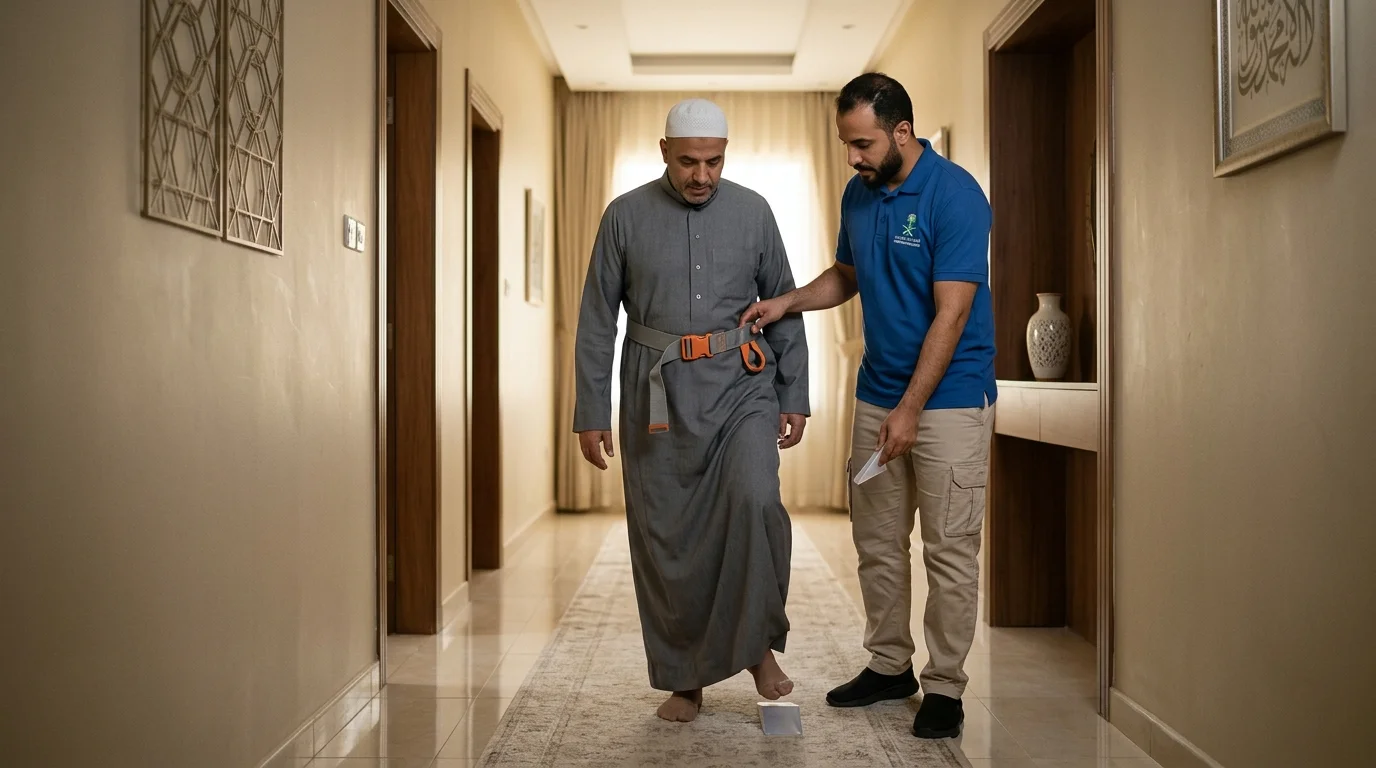
Neurological gait retraining session focusing on heel-strike kinematics and safe stride balance at home
1

Biomechanics of Normal vs Pathological Neurological Gait

The human gait cycle is an intricate sensory-motor sequence composed of two primary intervals: the stance phase (representing approximately 60% of the stride), requiring profound lower limb stability and weight acceptance, and the swing phase (40%), demanding active limb shortening, hip flexion, and precise foot clearance.

When central or peripheral nervous system lesions occur, this harmonious kinematic chain disintegrates. In hemiplegic stroke survivors, impaired hip extensor control and quadriceps spasticity often provoke violent knee recurvatum (hyperextension) during midstance, while ankle dorsiflexor weakness impairs ground clearance during swing. To prevent the paretic toes from dragging, the patient instinctively initiates 'circumduction gait' — swinging the paralyzed leg outward in a wide lateral arc using excessive pelvis elevation (hip hiking).

Conversely, in Parkinson's disease, patients exhibit a stooped, festinating gait characterized by rapid, diminutive steps and loss of reciprocal arm swing. In cerebellar ataxia, patients present with an irregular, wide-based, drunken-like staggering gait. Bidaya clinicians conduct comprehensive qualitative and quantitative observational gait analysis in the patient's home, isolating specific kinematic deficits and designing targeted interventions rather than encouraging unstructured, compensatory walking.

Re-establishing initial heel strike to eliminate hazardous forefoot slapping.
Strengthening hip abductors (gluteus medius) to eradicate Trendelenburg pelvic drop.
Training eccentric quadriceps control for smooth shock absorption during loading response.
Facilitating dynamic terminal push-off via gastroc-soleus recruitment.
2

Scientific Progression of Walking Assistive Devices

Patients frequently become prematurely dependent on inappropriate walking aids, reinforcing abnormal asymmetry. Bidaya institutes a strict, evidence-based assistive device progression:

1. Front-Wheeled Walker (Rollator): Provides maximum bilateral stability and wide base of support during initial post-discharge rehabilitation or severe ataxia.

2. Hemi-Walker: Ideal for hemiplegic stroke patients who have functional use of only one upper extremity, offering a broad, stable support platform.

3. Quad Cane (Four-Pronged Cane): Introduced as single-leg stance stability improves, allowing nimble indoor hallway and room maneuvering while ensuring reliable floor contact.

4. Single-Point Medical Cane: The final transitional device before independent walking, enhancing proprioceptive feedback and offloading 10-15% of joint force.

5. Independent Unassisted Ambulation: The ultimate goal, unlocked once standardized dynamic balance thresholds (Berg Balance > 45, dynamic gait index > 19) are achieved.

3

Advanced In-Home Gait Challenges and Dual-Task Training

True community independence requires navigating dynamic domestic realities:

Dual-Task Gait Training: Training patients to ambulate while carrying a light object or answering conversational questions, ensuring motor automaticity and fall prevention when cognitive attention is divided.

Multi-Directional Stepping & Pivot Turns: Teaching wide-arc segmental turns rather than hazardous single-limb pivot twisting.

Surface Transitions: Safely transitioning between smooth marble tiles, thick carpets, and outdoor paved verandas under direct clinical supervision.

4

Orthotic Management and Functional Electrical Stimulation

In persistent foot drop or ankle instability, our therapists collaborate to fit and tune customized Ankle-Foot Orthoses (AFO) — such as dynamic carbon-fiber energy-return splints — and apply Functional Electrical Stimulation (FES) to the common peroneal nerve to synchronize dorsiflexion during the swing phase.

5

Advanced In-Home Clinical Assessment Battery and SMART Milestones for Neurological Gait Disorders

The clinical success of in-home neurological rehabilitation for Neurological Gait Disorders depends fundamentally on the depth and precision of the baseline diagnostic evaluation performed in the patient's residence. Rather than relying on subjective observation or generic exercise routines, Bidaya implements an internationally standardized clinical assessment battery designed to map the structural and functional integrity of the central and peripheral nervous systems.

Our comprehensive baseline evaluation quantifies muscle tone and velocity-dependent spasticity using the Modified Ashworth Scale (MAS), isolates selective voluntary motor control outside pathological mass synergies via the Fugl-Meyer Assessment (FMA), and evaluates static and dynamic equilibrium using the Berg Balance Scale (BBS) and the Timed Up and Go (TUG) test. Sensory modalities — including light touch discrimination, pinprick, and joint position sense (proprioception) — are meticulously charted to identify sensory ataxia or neglect syndromes.

Based on these objective metrics, our senior neurological physiotherapist collaborates with the patient and family to establish Specific, Measurable, Achievable, Relevant, and Time-bound (SMART) functional milestones. These goals are explicitly tied to authentic daily domestic routines: mastering unassisted rolling in bed within two weeks, rising autonomously from a standard residential armchair within four weeks, or achieving stable indoor ambulation across domestic hallways without physical assistance.

Precise neurological documentation tracking deep tendon reflexes and clonus suppression.
Continuous physiological monitoring of blood pressure, heart rate, and oxygen saturation during exertion.
Targeted identification of isolated muscle deficits to guide functional neuromuscular stimulation (NMES).
Sharing comprehensive digital progress summaries with treating physicians across Eastern Province hospitals.
6

Caregiver Empowerment and Domestic Safety Protocols for Neurological Gait Disorders

Extensive peer-reviewed rehabilitation research demonstrates that while direct clinical therapy sessions provide high-intensity neuroplastic stimulation, the remaining 23 hours of the patient's day are managed by family members and domestic caregivers. If caregivers lack proper biomechanical training, well-intentioned assistance — such as aggressively pulling on a hemiparetic arm during transfers — can produce catastrophic musculoskeletal injuries, severe shoulder subluxation, and chronic pain syndromes.

Bidaya dedicates structured time during every home visit to coach family members and domestic nurses in safe, ergonomic transfer mechanics. We train the biomechanical 'Head-Hips Relationship' to facilitate effortless transfers between bed, wheelchair, and sofa without placing compressive strain on the caregiver's spine, alongside strict rotational repositioning protocols to eliminate pressure injury risks.

Furthermore, we provide structured, illustrated Home Exercise Programs (HEP) detailing gentle active-assisted movements, safe positioning techniques using anatomical pillows, and clear activity boundaries, transforming the household into an empowering 24-hour therapeutic sanctuary.

Strict prohibition of traction forces on the paretic shoulder to prevent rotator cuff tears.
Anatomical positioning guidelines using contoured pillows to preserve symmetrical trunk alignment.
Training caregivers to encourage active patient participation rather than fostering learned helplessness.
Direct coordination channels with the supervising clinician for prompt guidance on daily care challenges.
7

Local Residential Adaptation and Mobile Clinical Field Logistics in Eastern Province

Residential properties in Eastern Province feature generous architectural spaces that provide outstanding opportunities for neurological motor relearning, including expansive living halls, wide hallways, and private outdoor verandas. However, these spaces also present real-world environmental hazards — such as polished marble flooring, decorative floor rugs, and threshold steps — that can precipitate dangerous falls if unmanaged.

During our initial home visits in Eastern Province, Bidaya clinicians conduct a thorough domestic safety audit, identifying slip and trip hazards and advising families on practical, unobtrusive modifications. These include securing rug perimeters, recommending secure wall-mounted grab bars in bathrooms, optimizing lighting along nocturnal pathways, and adjusting seating heights to match the patient's biomechanical joint angles.

Moreover, our mobile operations in Eastern Province are strategically scheduled by regional neighborhood clusters, ensuring prompt, reliable arrival that avoids peak arterial highway congestion and preserves the patient's physiological stamina for productive therapeutic exercise.

Systematic hazard screening across hallways, thresholds, and bathroom transfer zones.
Optimizing residential seating heights to facilitate natural sit-to-stand momentum transfer.
Coordinating session arrival to harmonize with patient medication schedules and prayer times.
Customizing mobility training to the unique architectural dimensions of the patient's residence.
8

Comprehensive Clinical Prevention of Secondary Complications in Neurological Gait Disorders

Effective management of chronic or subacute Neurological Gait Disorders requires aggressive prevention of secondary complications arising from prolonged immobility or abnormal compensatory kinematics. Left unaddressed, these secondary pathologies can become more physically limiting and painful than the primary neurological lesion itself.

Chief among these risks are fixed soft-tissue contractures resulting from sustained uninhibited spasticity, disuse osteoporosis caused by lack of skeletal axial loading, dependent peripheral edema with deep vein thrombosis (DVT) risk, and pulmonary atelectasis stemming from shallow diaphragmatic excursion during prolonged recumbency.

Bidaya's home neuro-physiotherapy integrates multi-tiered preventive strategies: applying sustained low-load prolonged stretching to vulnerable muscle groups, introducing supported weight-bearing standing protocols to stimulate osteogenesis, utilizing active muscle pumps and electrical stimulation to enhance venous return, and practicing deep diaphragmatic re-expansion to maintain pulmonary compliance.

Regular passive and active-assisted range of motion protocols to preserve articular mobility.
Facilitating safe upright standing to stimulate bone mineral density and reduce spastic tone.
Activating calf muscle pump mechanisms to prevent dependent peripheral edema and circulatory stasis.
Incentive spirometry and diaphragmatic breathing exercises to safeguard respiratory vitality.
9

Clinical Governance, Objective Documentation, and Quality Benchmarks at Bidaya

Bidaya adheres strictly to international clinical governance frameworks established by premier neurological physical therapy organizations worldwide. Our home visit service is characterized by rigorous longitudinal documentation and transparent milestone verification using validated outcome batteries.

At the conclusion of each therapeutic block, our supervising clinical director reviews serial functional scores (Fugl-Meyer, Berg Balance, TUG, and Modified Barthel Index), synthesizing these data points into an encrypted clinical progress report. This report is shared directly with the patient, family, and treating neurologist at tertiary centers across the Eastern Province, ensuring seamless multidisciplinary continuity of care.

Serial digital outcome tracking verifying functional gains at standardized intervals.
Peer-reviewed clinical protocol updates incorporating the latest neuroplasticity research.
Absolute confidentiality and ethical data stewardship safeguarding family medical privacy.
Uncompromising dedication to restoring patient dignity, self-reliance, and physical autonomy.
10

Long-Term Motor Maintenance and Sustainable Community Reintegration

Neurological recovery is a cumulative, lifelong journey requiring continuous synaptic reinforcement to prevent disuse deconditioning and regression. Bidaya establishes a phased transitional framework that guides patients from intensive restorative therapy to autonomous domestic mobility and sustained physical vitality.

We train patients and family members to embed therapeutic exercises seamlessly into natural daily rituals: practicing dynamic balance during daily standing routines, actively utilizing the paretic extremity for stabilizing household items, and undertaking supervised daily walking along secure residential corridors or private garden pathways.

Establishing an enduring home exercise routine that safeguards neuromuscular gains.
Periodic monthly clinical follow-ups to re-evaluate balance metrics and gait velocities.
Progressive calibration of home exercise resistance and balance difficulty levels.
Fostering psychological resilience and active participation in family and social life.

Gait & Balance Clinical Rehabilitation Topics

Neurological Balance Retraining and Fall PreventionEastern ProvinceAdvanced Neurological Foot Drop Rehabilitation and Gait RestorationEastern ProvinceIn-Home Gait Retraining and Walking Recovery Following StrokeEastern ProvinceIn-Home Post-Stroke Balance Retraining & Fall PreventionEastern ProvinceIn-Home Foot Drop Correction & Gait Facilitation Post-StrokeEastern ProvinceProgression from Wheelchair to Independent Ambulation Post-StrokeEastern ProvinceSafe Medical Walker Training & Ambulation Post-StrokeEastern ProvinceCan Functional Walking Be Restored After a Stroke?Eastern ProvinceSafe Stair Climbing & Descent Retraining After StrokeEastern ProvinceClinical In-Home Medical Walker Training for Neurological PatientsEastern ProvinceIn-Home Stair Navigation & Climbing Retraining for Neurological ConditionsEastern ProvinceStatic & Dynamic Standing Balance Retraining in Neurological CareEastern ProvinceSeated Postural Balance & Trunk Core Stability in Neuro RehabilitationEastern ProvinceDual-Task Gait & Cognitive-Motor Balance Retraining at HomeEastern ProvinceAtaxic Hemiparesis & Incoordination Rehabilitation After StrokeEastern ProvinceDiabetic Peripheral Neuropathy & Sensory Balance RehabilitationEastern ProvinceAnkle-Foot Orthosis (AFO) Selection & Dynamic Fitting GuideEastern ProvinceWireless Functional Electrical Stimulation (FES) for Foot Drop AmbulationEastern ProvinceCharcot-Marie-Tooth (CMT) Disease Gait Stabilization & Physical TherapyEastern ProvinceObservational Gait Analysis & Stride Biomechanics in Home Neuro-RehabEastern ProvinceSensory Ataxia, Positive Romberg Sign & Spatial Balance TherapyEastern ProvinceVestibular-Ocular Reflex (VOR) & Neuro-Vestibular Balance RehabilitationEastern ProvinceFour-Wheel Rollator Ergonomics, Braking Control & Posture AlignmentEastern ProvinceReactive Perturbation Balance Training & Trip Recovery MechanicsEastern ProvinceStep-by-Step Clinical Spotting Guide for Ascending & Descending StairsEastern ProvinceOvercoming Stair Climbing Difficulties After Neurological InjuryEastern ProvinceRetraining Impaired Seated Equilibrium & Weight-ShiftingEastern ProvinceTreating Severe Standing Balance Deficits & Postural SwayEastern ProvinceManaging Reduced Walking Stamina & Neurological Motor FatigueEastern ProvinceManaging Sudden Knee Buckling & Extensor Lag During StanceEastern ProvinceOvercoming Slow Shuffling Gait & Step Initiation HesitationEastern ProvinceCorrect Walker Height Alignment, Postural Symmetry & BrakingEastern ProvinceClinical Progression from Walker to Single-Point Cane Post-StrokeEastern ProvinceCircumduction Gait & Compensatory Hip Hiking Correction Post-StrokeEastern ProvinceSpastic Equinovarus Deformity & Toe-Walking Management Post-StrokeEastern ProvinceLocomotor Symmetry & Gait Speed Recalibration Post-StrokeEastern ProvinceSensory Gait Retraining & Equilibrium in Diabetic NeuropathyEastern ProvinceSafe Gait Spotting: How to Walk Beside an Unsteady PatientEastern ProvinceCan Wheelchair-Bound Patients Walk Again? Realistic Clinical PrognosisEastern Province
Safety Screening

Home Fall Risk Educational Check

Identify potential mobility challenges, furniture leaning, and domestic hazards that impact balance confidence.

Frequently Asked Clinical Questions

Q

Does prolonged walker use create permanent dependence for stroke patients?

A walker is an essential early safety intervention to prevent catastrophic fractures. Through systematic balance and gait retraining, our clinicians continuously re-evaluate physical capacity, tapering assistive support toward a cane and independent ambulation as soon as motor control allows.

Q

Why does a stroke patient swing their paretic leg in an outward circle when walking?

This outward arc (circumduction) compensates for weak hip flexion and inability to lift the toes (foot drop). By swinging the leg sideways, the patient prevents their toes from catching the ground. We correct this by strengthening hip flexors and fitting supportive AFO orthoses.

Q

How do we determine when a patient is ready to transition from a cane to walking unassisted?

Readiness is determined through standardized functional assessments (e.g., Berg Balance Scale, Timed Up and Go) demonstrating single-leg stance stability, automatic stepping reactions, and consistent postural recovery during mild perturbations.

Q

Is indoor walking barefoot better than wearing supportive shoes?

We strongly advise wearing closed-toe supportive athletic or orthopedic shoes with non-skid rubber soles during training. Walking barefoot or in socks dramatically increases slipping hazards and lacks the biomechanical arch support needed for neurological gait stability.

Q

How many daily walking steps are recommended during early home rehabilitation?

Step volume is progressed incrementally based on cardiovascular endurance and muscle fatigue. We prioritize movement quality and correct gait kinematics over high step counts, beginning with short, focused intervals (10-20 meters) repeated throughout the day.

Q

How do I book an in-home gait evaluation in Dammam or Khobar?

Contact Bidaya directly at 01097079170 or via WhatsApp (201097079170) to schedule a comprehensive in-home observational gait and balance analysis.

Regional Coverage Matrix

In-Home Neurological Gait Disorders Across Eastern Province

Our licensed neuro-physiotherapists deliver home-based rehabilitation programs to patients' residences in the following major cities:

Bidaya Neuro-Rehabilitation Clinical Review BoardClinical Governance
Multidisciplinary Physical Therapy & Neurological Care Panel — Eastern Province
Last Clinical Review: 2026-09-03
Editorial Standards
Evidence-Based Clinical References
  • Perry J, Burnfield JM. Gait Analysis: Normal and Pathological Function. Slack Inc; 2010.
  • Dobkin BH. Training and exercise to promote neuroplasticity after stroke. Neurorehabil Neural Repair. 2008.
  • States RA, et al. A review of assistive devices for ambulation. J Geriatr Phys Ther. 2011.
  • Bohannon RW. Comfortable and maximum walking speed reference values. Age Ageing. 1997.
Clinical Governance & Care Standards

Why Families Trust Bidaya Home Neuro-Rehab

Evidence-informed neurological care delivered with domestic safety, medical ethics, and documented functional recovery.

100% Dedicated In-Home Care

Eliminates transportation strain and clinical waiting times for neurological patients.

Licensed Clinical Professionals

Qualified physical therapists trained in adult neurological rehabilitation.

Standardized Outcome Measures

Baseline assessment and objective tracking using validated international metrics.

Caregiver & Family Training

Instruction on safe transfer mechanics, positioning, and daily home routines.

Exclusive Neurological Focus

Specialized clinical programs tailored to stroke, Parkinson's, and mobility disorders.

Eastern Province Wide Coverage

Scheduled home care visits covering Dammam, Khobar, Dhahran, Qatif, Jubail, and Al-Ahsa.

All clinical sessions are scheduled following an initial in-home clinical needs assessment.