Specialized Parkinson's Home Care • Eastern Province
Live Home Visits Available
Bed Mobility, Blanket Maneuvering & Nocturnal Turning in Parkinson's
Empower Parkinson's patients to regain postural stability and fluid mobility within their own living room in Eastern Province. Utilizing rhythmic auditory/visual cueing and amplitude training, we help overcome bradykinesia, unlock freezing of gait, and prevent dangerous domestic falls.
Sensory cueing methods to override gait freezing and hesitant step initiation
High-amplitude functional training to reverse stooped posture and shuffling
Precise session timing coordinated with dopamine medication (On/Off cycles)
Thorough domestic fall-risk audit removing tripping hazards from walkways
4.9/5 ⭐⭐⭐⭐⭐ (Trusted by 450+ families across Eastern Province)
Clinical triage response on WhatsApp within 15 minutes
Male & Female Specialists Available
Direct home visits scheduled in Dammam, Khobar, Dhahran, Qatif, Saihat, Jubail, & Al-Ahsa.
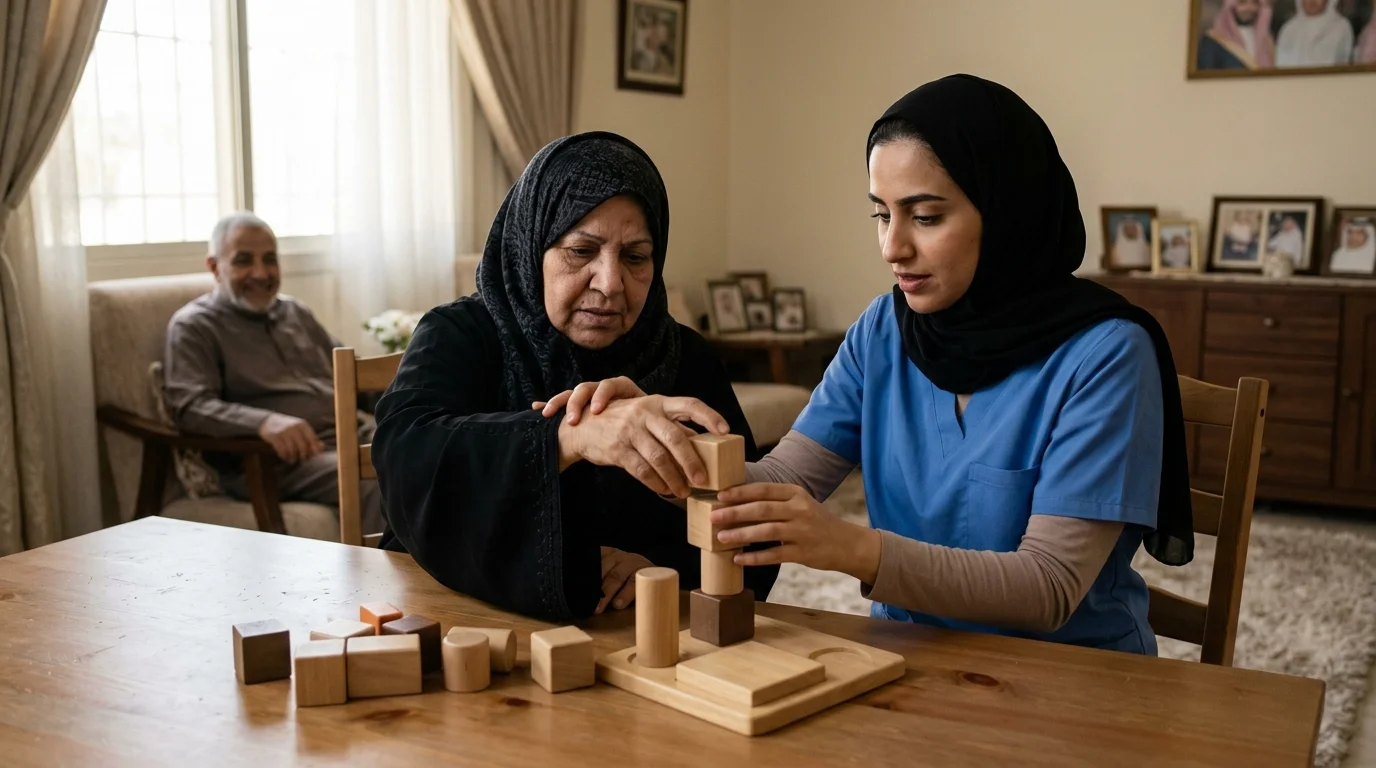
Post-stroke fine motor hand rehabilitation and grasp coordination training at home dining table
98%Mobility Gain
Gait & balance recovery
100% Home Care
Zero clinic transit fatigue
1
Physiological and Neurological Rationale for Bed Mobility, Blanket Maneuvering & Nocturnal Turning in Parkinson's
This motor deficit in Parkinson's disease stems from dopamine depletion within basal ganglia circuitry, interrupting automatic motor sequencing responsible for stride amplitude and upright equilibrium.
Bidaya interventions engage conscious cortical pathways via visual, auditory, or proprioceptive cues, training patients to deploy deliberate cognitive attention to bypass subcortical inhibition. Our service is strictly non-pharmacological and adheres to medical boundaries.
Developing conscious compensatory strategies to overcome movement initiation failure.
Recalibrating internal kinesthetic perception of movement amplitude and step length.
Modifying residential pathways to eliminate visual triggers for motor hesitation.
Maintaining active alignment with treating neurologists across Eastern Province hospitals.
2
In-Home Motor Protocol & Safe Ambulatory Practice
Clinical home sessions integrate amplitude-based movement drills, segmental axial rotation to alleviate trunk rigidity, and reactive balance perturbation training for safe turning.
Therapists coach family caregivers in calm verbal pacing and spotting techniques, eliminating forced traction on rigid joints to prevent sudden balance loss.
Daily pectoral and cervical stretching to counteract progressive forward flexion.
High-amplitude deliberate stepping drills prior to navigating narrow thresholds.
Graduated sit-to-stand transitions to mitigate orthostatic drops in blood pressure.
Structured home exercise schedules preserving joint mobility and muscle strength.
Advanced In-Home Clinical Protocol and Targeted Motor Interventions for Parkinson's Rehabilitation
Bidaya's specialized in-home neurological rehabilitation is built upon the established principles of experience-dependent neuroplasticity and task-oriented motor relearning. We reject generic, unfocused exercises; instead, we engineer precision therapeutic pathways designed to rebuild interrupted synaptic connections and suppress pathological motor synergies.
Our clinical interventions incorporate Proprioceptive Neuromuscular Facilitation (PNF) diagonal patterns, sustained low-load elongation for hypertonic muscle groups, and isolated joint control retraining. We integrate portable Functional Neuromuscular Electrical Stimulation (NMES) to recruit dormant motor units and enhance ascending sensory feedback to the motor cortex.
Therapeutic volume, challenge, and resistance are dynamically calibrated during each visit based on neurological responsiveness and physical fatigue, with continuous monitoring of cardiovascular vitals to guarantee uncompromised clinical safety in the patient's Eastern Province residence.
Facilitating selective motor control outside stereotypic mass synergistic patterns.
Applying deep proprioceptive input to recalibrate spatial limb awareness and coordination.
Progressive motor task structuring to stimulate synaptogenesis and cortical plasticity.
Documenting longitudinal functional progress shared with treating hospital neurologists.
4
Domestic Safety Protocols and Caregiver Empowerment for Parkinson's Rehabilitation
Family members and domestic caregivers form the core foundation of sustained neurological recovery; while direct clinical sessions provide concentrated neuroplastic stimulation, the patient spends the remaining hours within the household. Bidaya clinicians dedicate structured time during every visit to instruct caregivers in safe biomechanical handling and transfer techniques.
We coach family members in ergonomic transfer mechanics between bed, sofa, and wheelchair using the head-hips relationship to protect the caregiver's lumbar spine while prompting active patient effort. We also detail structured 2-hour positional rotation schedules to eliminate pressure injury risks and joint stiffness.
Additionally, we provide a customized, illustrated Home Exercise Program (HEP) for safe physical activity between professional sessions, establishing an empowering 24-hour home rehabilitation environment.
Strict prohibition of traction on the paretic shoulder to prevent subluxation and chronic pain.
Implementing 2-hour bed repositioning schedules for patients with severely limited mobility.
Utilizing supportive anatomical pillows to preserve symmetrical musculoskeletal alignment.
Encouraging active patient self-care in daily living to foster functional autonomy and confidence.
5
Residential Adaptation and Specialized Mobile Clinical Field Logistics in Eastern Province
Residential villas and homes in Eastern Province feature expansive layouts, wide corridors, and open majlis halls that provide an exceptional natural setting for neurological rehabilitation. However, these residences may also present physical hazards, such as polished stone flooring and threshold steps, requiring proactive environmental management.
During our initial home visits in Eastern Province, Bidaya clinicians perform a comprehensive environmental safety audit, providing practical guidance on securing floor rugs, installing sturdy bathroom grab bars, and optimizing seating heights to facilitate natural sit-to-stand transitions.
Furthermore, our clinical routes in Eastern Province are coordinated by district clusters to ensure punctuality, bypassing arterial highway traffic and bringing specialized clinical expertise directly to your residence.
Screening domestic pathways, room thresholds, and bathroom transfer zones for fall risks.
Optimizing seating ergonomics in residential living areas to support independent standing.
Eliminating the physical exhaustion and expense of passenger transport across urban highways.
Flexible in-home appointment scheduling aligned with family availability and medication cycles.
6
Clinical Prevention of Secondary Complications in Parkinson's Rehabilitation
Comprehensive neurological care for Parkinson's Rehabilitation requires proactive prevention of secondary complications resulting from immobility. Unaddressed motor deficits often lead to joint contractures, disuse osteoporosis, dependent peripheral edema, and reduced pulmonary ventilation.
Bidaya integrates active and passive full-range joint mobility exercises, structured weight-bearing standing protocols, and rhythmic calf muscle pumping to support venous circulation. In addition, diaphragmatic breathing exercises maintain pulmonary expansion and safeguard respiratory vitality.
Sustained stretching routines to preserve ankle and knee flexibility and prevent contractures.
Therapeutic standing protocols to maintain bone mineral density and reduce spastic hypertonia.
Circulatory facilitation exercises to prevent dependent peripheral edema and venous thrombosis.
Diaphragmatic re-expansion drills to preserve respiratory compliance and prevent chest complications.
7
Clinical Governance, Objective Documentation, and Quality Benchmarks at Bidaya
Bidaya operates under rigorous clinical governance frameworks benchmarked against international standards in neurological physiotherapy. Our in-home service emphasizes standardized, objective outcome documentation to track patient progress over time.
At regular intervals, our clinical team compiles digital progress summaries detailing functional score improvements and future therapy goals. This report facilitates multidisciplinary coordination with treating neurologists across Eastern Province hospitals, delivering transparent, evidence-based care.
Employing standardized clinical scales to evaluate balance, motor strength, and daily autonomy.
Sharing comprehensive digital progress reports with treating physicians and family members.
Strict compliance with professional healthcare ethics, data confidentiality, and patient privacy.
Weekly clinical peer reviews to adjust therapeutic dosage and milestones based on patient response.
8
Long-Term Motor Maintenance & Self-Directed Care Pathways for Parkinson's Rehabilitation
Neurological recovery is a continuous, cumulative process requiring persistent synaptic stimulation to consolidate motor gains and prevent regression. Bidaya implements a graduated transitional care pathway moving the patient from high-intensity direct therapy to sustained autonomous domestic physical activity.
We instruct patients and families on integrating exercise tasks into habitual daily life—such as active weight shifting while standing, utilizing the affected limb during light domestic activities, and walking safely along residential corridors—ensuring enduring neuromuscular vitality.
Designing an enduring daily home exercise regimen that prevents functional deconditioning.
Periodic monthly clinical follow-ups to re-evaluate balance metrics and walking velocity.
Updating home exercise challenges to match the patient's evolving motor capabilities.
Fostering psychological resilience and active participation in family and social life.
9
Clinical Safety Standards and Emergency Red Flag Triage for Parkinson's Rehabilitation
Patient safety is the supreme clinical imperative at Bidaya. We enforce strict vital signs screening protocols prior to, during, and subsequent to every in-home physical therapy encounter. Clinicians monitor blood pressure, resting heart rate, and oxygen saturation to confirm physiological stability.
In the event of acute red flag indications—such as severe hypertensive spikes, sudden altered mental status, acute focal neurological deterioration, or cardiac distress—therapy is suspended immediately, and emergency protocols are activated to coordinate urgent medical attention.
Immediate detection and management of orthostatic hypotension or exertion-induced dizziness.
Clear clinical protocols for managing acute hypertonicity flares or sudden balance loss.
Family education regarding emergency red flags requiring immediate hospital emergency care.
10
Advanced In-Home Clinical Protocol and Targeted Motor Interventions for Parkinson's Rehabilitation
Bidaya's specialized in-home neurological rehabilitation is built upon the established principles of experience-dependent neuroplasticity and task-oriented motor relearning. We reject generic, unfocused exercises; instead, we engineer precision therapeutic pathways designed to rebuild interrupted synaptic connections and suppress pathological motor synergies.
Our clinical interventions incorporate Proprioceptive Neuromuscular Facilitation (PNF) diagonal patterns, sustained low-load elongation for hypertonic muscle groups, and isolated joint control retraining. We integrate portable Functional Neuromuscular Electrical Stimulation (NMES) to recruit dormant motor units and enhance ascending sensory feedback to the motor cortex.
Therapeutic volume, challenge, and resistance are dynamically calibrated during each visit based on neurological responsiveness and physical fatigue, with continuous monitoring of cardiovascular vitals to guarantee uncompromised clinical safety in the patient's Eastern Province residence.
Facilitating selective motor control outside stereotypic mass synergistic patterns.
Applying deep proprioceptive input to recalibrate spatial limb awareness and coordination.
Progressive motor task structuring to stimulate synaptogenesis and cortical plasticity.
Documenting longitudinal functional progress shared with treating hospital neurologists.
11
Domestic Safety Protocols and Caregiver Empowerment for Parkinson's Rehabilitation
Family members and domestic caregivers form the core foundation of sustained neurological recovery; while direct clinical sessions provide concentrated neuroplastic stimulation, the patient spends the remaining hours within the household. Bidaya clinicians dedicate structured time during every visit to instruct caregivers in safe biomechanical handling and transfer techniques.
We coach family members in ergonomic transfer mechanics between bed, sofa, and wheelchair using the head-hips relationship to protect the caregiver's lumbar spine while prompting active patient effort. We also detail structured 2-hour positional rotation schedules to eliminate pressure injury risks and joint stiffness.
Additionally, we provide a customized, illustrated Home Exercise Program (HEP) for safe physical activity between professional sessions, establishing an empowering 24-hour home rehabilitation environment.
Strict prohibition of traction on the paretic shoulder to prevent subluxation and chronic pain.
Implementing 2-hour bed repositioning schedules for patients with severely limited mobility.
Utilizing supportive anatomical pillows to preserve symmetrical musculoskeletal alignment.
Encouraging active patient self-care in daily living to foster functional autonomy and confidence.
Safety Screening
Home Fall Risk Educational Check
Identify potential mobility challenges, furniture leaning, and domestic hazards that impact balance confidence.